
This issue is all about evolution: of buyers, brands, and the ways we connect. From B2B buyer journeys being rewritten by chatbots and their AI brethren, to healthcare marketers needing to (compliantly) innovate, to brands predicting customer needs before they even click—it’s all about staying smart, agile, and one step ahead.
Let’s dive in.
🤖 How AI Is Rewriting the B2B Buyer Journey
For years, B2B marketing was simple(ish): rank on Google, nurture leads, retarget across channels, repeat. But—stop us if you’ve heard this one—AI has changed the game. Large language models (LLMs) like ChatGPT, Claude, and Gemini are reshaping how buyers discover and decide. Instead of browsing links, they’re asking questions—and getting summarized, action-ready answers.
That means your perfectly optimized content might never be seen unless it’s cited or surfaced inside an AI response. Welcome to the era of AEO—AI Engine Optimization—where freshness, structure, and credibility matter more than backlinks and keywords.
Why This Matters
- The buyer journey just got shorter: Discovery, consideration, and evaluation now happen in one AI chat.
- Visibility depends on AI trust: If LLMs don’t view your content as relevant or credible, you’re invisible.
- Experimentation beats perfection: AI platforms evolve fast—what works today may vanish tomorrow.
- Fresh content wins: Outdated material rarely appears in AI-generated summaries.
What You Can Do
- Refresh content quarterly: Keep data and examples current so AI engines keep noticing you.
- Test visibility in AI chats: Ask buyer-style questions and see who shows up.
- Experiment fast: Treat campaigns as learning loops and adapt quickly.
- Bridge AI and ABM: Target precisely so your brand’s already top of mind when AI mentions your space.
AI isn’t just changing how buyers search—it’s changing who they ask. Make sure the answer includes you.
4 Big Takeaways from the 2025 MM+M Media Summit
If the 2025 MM+M Media Summit made one thing clear, it’s that healthcare marketers are juggling a lot—AI adoption, patient trust, omnichannel chaos, and an ongoing race to act more like consumer brands (without running afoul of HIPAA). Here are four major themes that emerged:
1. Pharma’s trust problem isn’t going away. The Reddit keynote drove home a key point: pharma brands can’t sit on the sidelines anymore. People want to talk about their health online—and if drugmakers don’t join the conversation with credible, human information, misinformation will fill the gap.
2. AI is the co-pilot, not the captain. Everyone’s using AI now, but no one’s handing over the keys. As one speaker put it, AI content is “good, but not good enough.” The sweet spot? Humans and machines working together to produce smart, scalable campaigns.
3. Omnichannel finally gets real. We’re (finally) moving from buzzword to execution. Marketers are getting clearer on what omnichannel actually means, how to measure it, and how to sustain “ongoing conversations” instead of stop-start campaigns.
4. Pharmacanplay more like consumer brands—if it breaks down silos. From faster MLR approvals to better cross-team collaboration, health marketers can connect with audiences more like consumer brands do (and better leverage AI), but only if they rethink old processes.
Health marketing is evolving fast—but so are audiences. So trust, personalization, and agility aren’t optional anymore. They’re the new prescription for relevance.
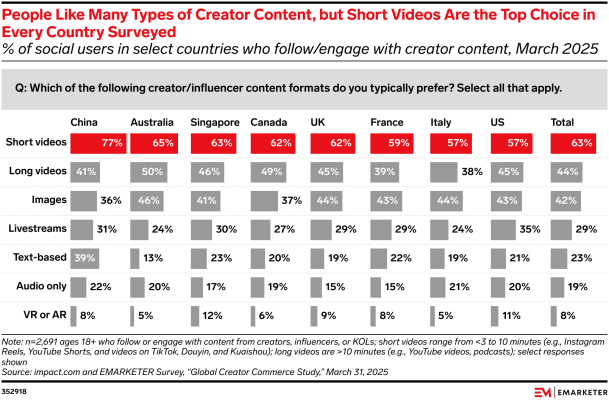
🌎 Short Videos Rule Ev-er-ywhere
🧠 Next Best Action: When AI Knows What Your Customer Needs Before They Do
Imagine a customer experience so spot-on it feels psychic. That’s the potential magic of the AI-powered “next best action”(aka experience)—an approach that uses data, machine learning, and gen AI to deliver the right message to the right customer at the right time. Instead of bombarding people with random offers, companies are using AI to anticipate what each customer actually needs—boosting satisfaction, revenue, and loyalty along the way.
Front-runners are already seeing results like a 15–20% lift in satisfaction, 5–8% more revenue, and up to 30% lower service costs.
What It Can Do
- Customers crave relevance—AI helps you deliver it at scale
- Disconnected teams and mixed messages drive churn (and unsubscribes)
- Smart sequencing of touchpoints can turn frustration into loyalty
- Predictive insights let you serve, not spam
The To Do List
- Start with a single high-impact use case (like churn prediction)
- Get your data house in order—AI only works as well as your inputs
- Create a unified contact strategy across departments
- Pilot, measure, refine—then scale what works
Remember: AI isn’t replacing human connection—it’s enhancing it. Brands that embrace “next best action” thinking now will be the ones customers want to connect with tomorrow.


