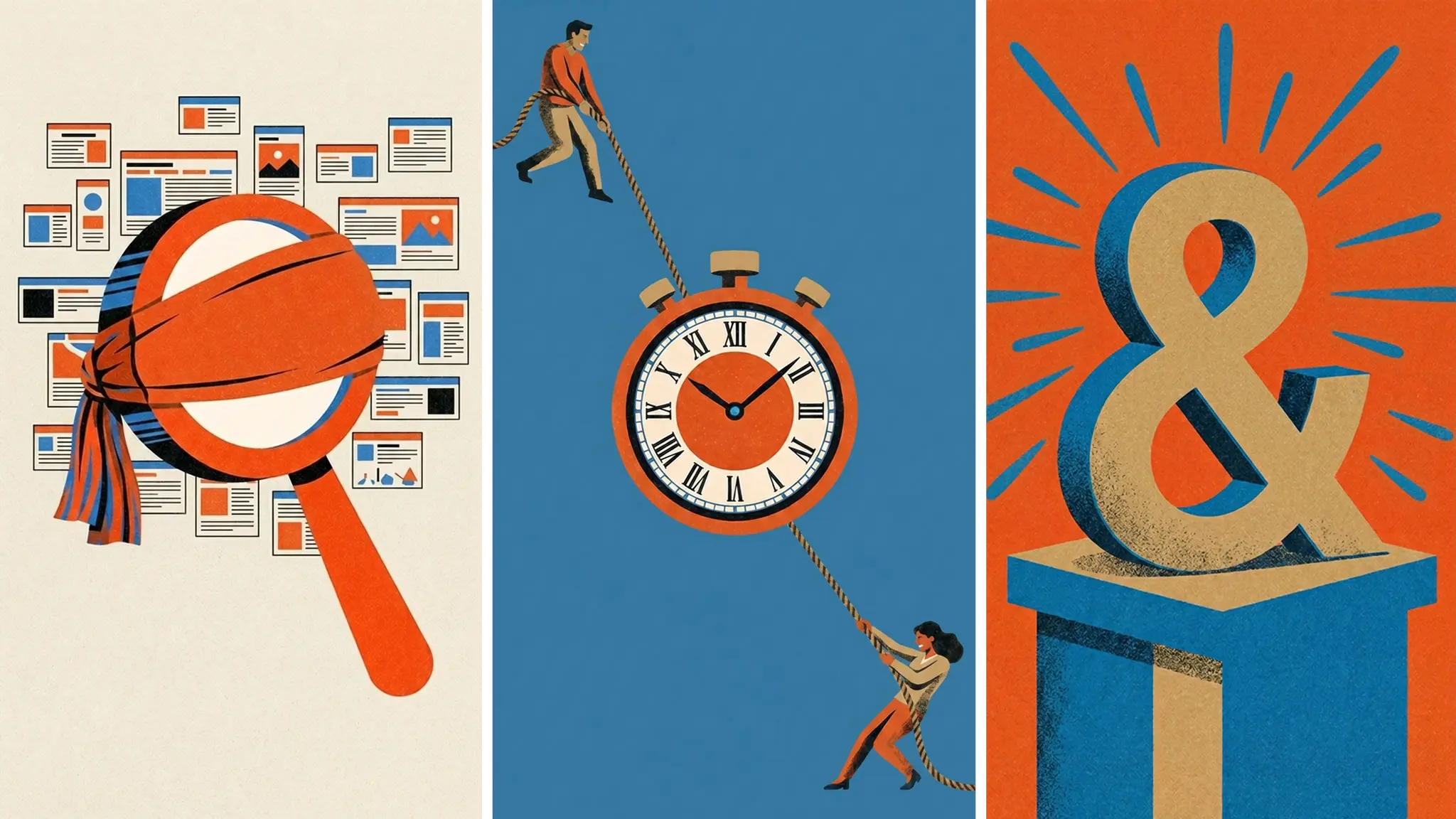
What do AI search, shrinking attention spans, and customer experience have in common? They’re all forcing marketers to rethink long-held assumptions. This week, we’re looking at why content gates may be hiding your expertise, why time is marketing’s scarcest resource, and why the brands people remember aren’t always the ones making the most noise.
Let’s dive in.
🔐 Is Content Gating Killing Your AI Search Visibility?
For years, marketers treated gated content like an ATM: insert whitepaper, collect marketing-qualified leads (MQLs). But in the age of AI search, that strategy may be working against you. While buyers are increasingly turning to ChatGPT, Claude, AI Overviews and the like to research vendors, some of your best, most AI search-friendly content may be hidden in places that can’t be crawled, cited, or recommended. What to do about it?
- Audit your content strategy for AI discoverability. If your most valuable content can’t be crawled, cited, or surfaced in AI-generated answers, it’s probably time to rethink the gate.
- Stop hiding your best thinking. Original research, benchmark data, and unique insights are exactly the types of content AI systems love to reference. If they’re locked behind a form, AI can’t see them.
- Optimize for influence, not just leads. Gated assets may generate contacts, but ungated content can earn visibility, backlinks, citations, and brand authority across both search and AI platforms.
- Don’t make buyers work for basic information. Product comparisons, use cases, pricing context, FAQs, and technical resources should be easy to find and consume.
- Adopt a hybrid approach. Publish key findings, methodology, charts, and takeaways on crawlable web pages, then offer deep-dive reports, raw data, or bonus content as optional downloads.
- Reserve gates for truly premium assets. Content such as personalized audits, proprietary tools, licensed analyst reports, and high-touch experiences still justify an email exchange.
- Think beyond MQLs. Modern buyers often prefer anonymous research. Friction-heavy forms can drive away prospects long before they’re ready to engage.
In an AI-driven search landscape, visibility is becoming as valuable as lead capture. The brands that win won’t necessarily be the ones collecting the most form fills. They’ll be the ones generously sharing expertise where buyers—and the AI they’re increasingly relying on—can actually find it.
Get more at Search Engine Land
⏱️ Why Every Marketing Strategy Is Really a Battle for Time
If attention is the most valuable currency in marketing, most of us are running around trying to spend it like there’s no tomorrow. In a recent interview, event design and experiential marketing expert Doug Binder makes a simple point: audiences may have more content choices than ever, but they still only have 24 hours in a day. The challenge isn’t creating more noise. It’s earning a place in the limited time people are willing and able to give.
Key takeaways for marketers:
- Stop thinking in impressions and start thinking in minutes. Every piece of content, campaign, event, and email competes against a finite resource: your audience’s time.
- Attention isn’t won with volume. More messages, more channels, and more content don’t automatically equal more engagement. In many cases, they just add to the noise.
- Lead with empathy—not targeting. Before you dive into audience data, understand the humans behind the personas. What problems are they facing? What pressures are they under? What would genuinely help them?
- Use data to answer the right questions. Audience insights matter, but only after you’ve identified the behaviors you’re trying to influence and the needs you’re trying to meet.
- Focus on creating value, not interruption. The brands that win attention are often the ones making life easier, not louder.
- Be memorable, not omnipresent. Whether through distinctive messaging, thoughtful content, or meaningful experiences, relevance beats repetition.
In a world drowning in content, attention is earned through relevance, empathy, and value. Marketers who treat audiences like people instead of targets will have a much better shot at winning both attention and trust.
🔗See the full interview at MarketingProfs
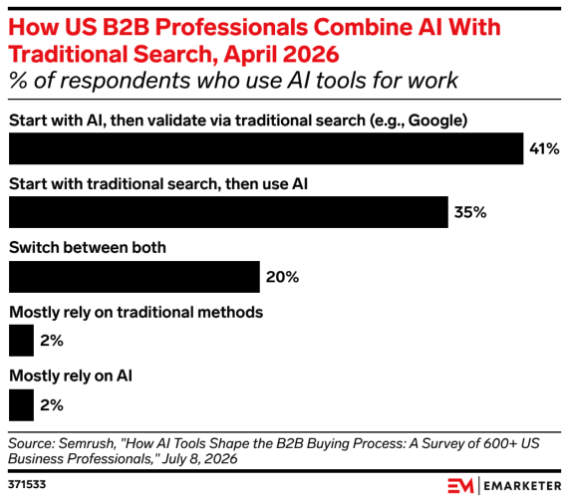
🔎 For B2B, It’s Not AI or Traditional Search, It’s “And”
❤️ The Brand-Building Power Hidden in Customer Experience
Customer experience has spent years quietly supporting marketing, sales, and operations. According to new research from JKR and Kantar, it may be time to move it to the head of the table. Turns out that memorable customer experiences aren’t just operational wins. They’re one of the most powerful drivers of brand growth, loyalty, and differentiation, especially when AI is increasingly shaping what customers see and consider. Here’s how to make the most of this opportunity:
- Don’t choose between emotion and logic. The strongest experiences satisfy both the head and the heart. Customers want experiences that are easy, effective, and friction-free—but also meaningful, memorable, and authentic.
- Remember that convenience is no longer a differentiator. Easy experiences aren’t a competitive advantage anymore. They’re the minimum admission price.
- Focus on creating “Meaningful Difference.” The experiences people remember and recommend are the ones that feel both useful and uniquely tied to the brand behind them.
- Ask better questions. Metrics like NPS and CSAT can tell you what happened. They rarely tell you why it happened or how customers actually felt.
- Think about AI as a customer, too. AI assistants increasingly learn from reviews, conversations, earned media, and customer feedback. Great experiences don’t just influence people. They influence the systems shaping future recommendations.
- Look for the moments that create advocacy, memorability, and adoption. These are often where growth opportunities are hiding.
Brand building doesn’t end when the campaign launches. Every customer interaction is now a branding moment, and increasingly, an AI training signal. The most successful brands won’t just be easy to do business with—they’ll be impossible to forget.


