
This week: turning social chatter into real business moves, fixing AI-powered CX before it starts annoying your customers, and why your martech stack might crack under pressure. Plus, a podcast that’s equal parts smart takes and chaos (the fun kind).
Let’s dive in.
🤖 From Bot to Brand Builder: Getting AI CX Right
As companies turn over more of their customer service to AI, the customers being serviced are making one thing clear: just because you can automate doesn’t mean you should. When 73% say support experiences define your brand, your chatbot isn’t just a tool—it’s a big influence on your reputation. Here are four critically important lessons:
- Know when humans need to step in. AI is great for quick wins—password resets, order tracking—but it falls apart when stakes are high. Billing issues, security concerns, and troubleshooting demand empathy. Make the handoff to a human fast, obvious, and frictionless.
- Segment like a marketer. Not all customers feel the same about AI. Preferences vary widely by gender and generation, and even Gen Z isn’t all-in on bots. Break down your CSAT and NPS data by audience to spot who’s embracing automation—and who’s one bad interaction away from churn.
- Play to AI’s strengths. Customers who do like AI want three things: speed, availability, and accuracy. If your bot can’t deliver those consistently, it’s not helping—it’s slowing everything down. Treat it like a product and optimize accordingly.
- Protect trust at all costs. Hidden bots, vague answers, and sketchy data practices are deal-breakers. Be transparent, set expectations, and make privacy crystal clear from the jump.
Bottom line: AI isn’t your shortcut to better CX—it’s your test. Nail the balance between automation and humanity, and you win. Miss it, and your “efficiency play” becomes a churn machine.
🪄Turning Social Listening Into Business Action
Marketers aren’t lacking data—they’re drowning in it. The real issue? That goldmine of social insight often isn’t making it out of the marketing department.
According to a Sprout Social report, 93% of professionals say social intelligence is critical for growth, but only 36% use it to inform decisions beyond marketing—creating massive internal blind spots.
So what should marketers actually do about it?
- Break the silo, or bust. Social data stuck in marketing is wasted potential. Build processes to get insights into product, CX, and strategy teams—fast.
- Clarify ownership. When social intelligence belongs to “everyone,” it belongs to no one. Define roles and accountability.
- Translate, don’t just report. Data isn’t the deliverable—action is. Package insights with clear recommendations so non-marketers know what to do with them.
- Use AI to cut through the noise. Social is messy and loud. AI can help filter signal from outrage and prevent overreacting to a vocal minority.
- Move at the speed of the scroll. 74% say social delivers insights faster than traditional research, so don’t let slow internal processes kill that advantage.
- Watch for costly missed signals. 33% of orgs missed cultural shifts, 31% missed changing preferences, and 21% lost market share due to poor use of social insights.
- Build confidence across levels. Adoption drops the farther you get from leadership. Train teams to trust and act on social data.
Social listening isn’t the win—activation is. The brands that turn real-time chatter into real-world decisions won’t just market better, they’ll outmaneuver the competition entirely.
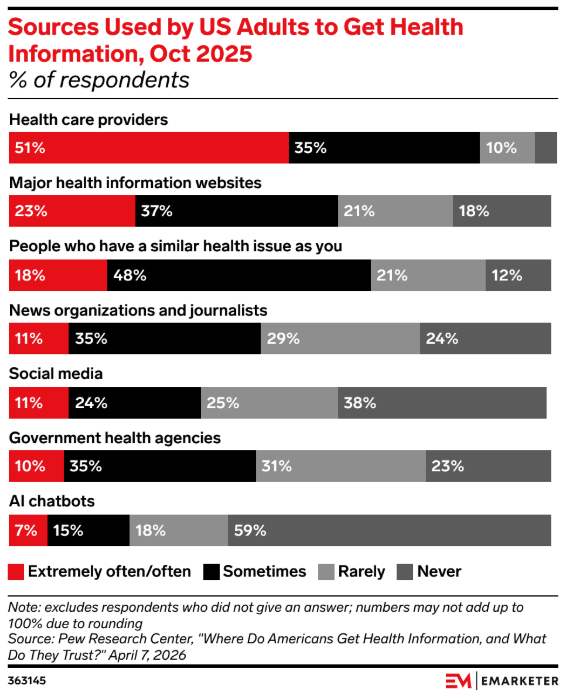
🩺 Real Docs Are Still Trusted Far More Than Dr. AI
📊 Fix Your Martech Stack Before AI Breaks It
Marketers have spent the last decade obsessing over data—collecting it, cleaning it, activating it. But here’s the thing: the real problem was never the data. It’s the plumbing.
Today’s typical marketing org is juggling 80–100+ platforms, all stitched together with brittle, hand-built integrations that break constantly. Now that AI agents are entering the workflow? That duct-taped stack is about to get exposed—fast.
How do you get things moving in the right direction?
- Audit your “invisible” bottleneck. You likely don’t have a data problem—you have a connectivity problem. Map your stack and identify where integrations are fragile, manual, or constantly breaking.
- Stop treating integration as a side project. Connectivity isn’t backend busywork—it’s core infrastructure. If your engineers are stuck fixing APIs all day, they’re not building for growth.
- Design for AI, not humans. Humans can work around broken systems. AI agents can’t. If integrations fail, workflows fail. Build for reliable, real-time, machine-to-machine communication.
- Prioritize interoperability over “best-of-breed.” That shiny new platform doesn’t matter if it can’t play nice with the rest of your stack. Optimization now depends on orchestration across systems, not isolated excellence.
- Invest in scalable, reusable connections. Custom connectors don’t scale—they create maintenance chaos. Look for solutions that offer standardized, pre-built, or self-healing integrations.
- Keep data where it belongs. As first-party data stays locked in your environment, prioritize architectures that allow secure, zero-copy connectivity rather than constant movement of data.
- Remember that AI won’t magically fix your marketing stack—but it will stress-test it. If your systems can’t talk to each other, your AI won’t either… and all that shiny new tech won’t move the needle one bit.
🔗Get the full story at MarketingProfs
🚨 New Podcast Alert!
What happens when you mix rapid-fire creative hot takes with the risk of eating a jelly bean that tastes like wet dog? Pure podcast gold. This episode, Heather Riexinger talks with Flynn Creative Supervisor Paul Hill about concept vs. craft, AI’s creative impact, and why “make it pop” might be the most dangerous feedback in advertising. It’s part creative masterclass, part survival game.


