Big marketing-related shifts are colliding right now—and none of them really care about your current strategy. Trust is shaky, AI is rewriting the journey, and digital ad growth is hiding chaos in plain sight. If you’re still playing by the old rules, it’s time for a reset.
Let’s dive in.
🤝 You Don’t Have a Content Problem—You Have a Trust Problem
Marketers have a trust problem—and most don’t even realize it. In a world flooded with polished content, thought leadership, and AI-generated everything, nearly every brand looks credible on the surface. But buyers aren’t just asking “Do I like this brand?”—they’re asking “Can I trust their judgment when it actually matters?” And that’s where things break down.
Here’s the kicker: more content doesn’t fix that gap. In fact, it can make it worse. B2B buyers are already drowning in helpful-but-generic material, and trust today depends less on volume and more on clarity and conviction.
So what actually builds real trust now?
- Make your thinking visible. Don’t just show what you do—show how and why you think. Buyers are evaluating judgment, not just capability.
- Stop “adding value”—start removing doubt. Content should reduce uncertainty, not just demonstrate expertise. If it doesn’t clarify the problem or decision, it’s just noise.
- Explain what others miss. Spell out the risks, tradeoffs, and blind spots your competitors gloss over—this is where credibility lives.
- Give your champions ammo. The real test of trust? Whether someone inside the org can confidently defend choosing you to stakeholders.
- Swap proof of activity for proof of reasoning. Case studies and frameworks matter—but only if they reveal the logic behind your recommendations.
- Align every touchpoint. Consistent thinking (not just consistent messaging) builds confidence across long, complex buying journeys.
Bottom line: trust isn’t built by just sounding human—it’s built by making your thinkingunmistakable. In a sea of sameness, the brands that win are the ones that show their work.
🔗Get the full story at SmartBrief
🤖 How to Win When AI Agents Call the Shots
Shopping in 2026 isn’t a journey—it’s a chaotic, AI-fueled mashup of moments. One minute you’re scrolling TikTok, the next an AI agent is comparison-shopping for you, and at times an in-store associate is still part of the mix. Welcome to the agent era, where brands don’t control the journey—but still get judged like they do.
What should marketers actually do about it?
- Show up where answers happen. Optimize for AI-powered “answer engines,” not just search—visibility now means being part of the answer, not the link.
- Guide, don’t just sell. Build experiences (and even your own agents) that help consumers evaluate, decide, and act across channels.
- Turn stores into stages. Physical retail wins when it’s immersive, social, and worth leaving the couch for.
- Support single conversations. Connect every touchpoint so customers never have to repeat themselves—continuity is the new loyalty driver.
- Make trust your moat. Transparency, control, and fairness aren’t nice-to-haves—they’re survival tactics in an AI-mediated world.
The new reality is that AI isn’t just another channel—it’s becoming the gatekeeper. For marketers, the game is no longer about winning attention; it’s about earning a place in the decisions machines make on your behalf.
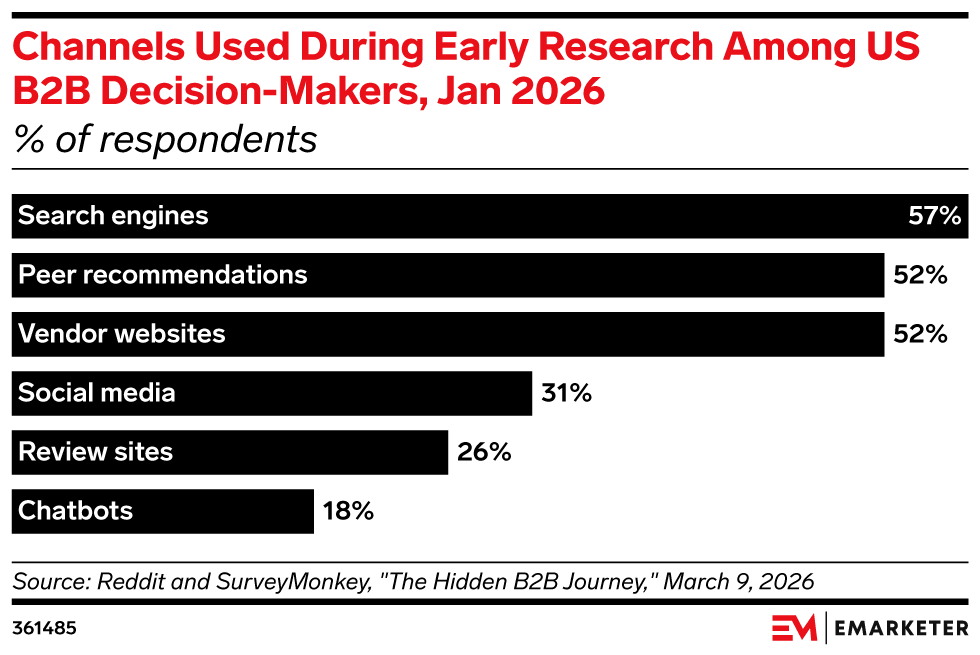
Where B2B Buyers Are Researching
💥 The Digital Ad Boom Is Real—So Is the Chaos
Here’s the thing about digital advertising right now: the top-line numbers look amazing… but the story underneath is way messier—and more interesting. According to EMARKETER’s Ad Buyer Strategies Summit, the market is on track to add more than $400 billion, yet the “rules” marketers have relied on are getting rewritten in real time.
Growth is masking a full-on reshuffling of power, platforms, and consumer behavior. What marketers should know (and do):
- Stop treating the “big three” as static. Amazon, Google, and Meta still dominate—but they’re aggressively invading each other’s turf, from retail media to lower-funnel conversion tools. Expect continued share shifts (hello, Amazon gains; Google dips) and plan budgets accordingly.
- Lean harder into retail media. Retailers are winning because they sit closer to purchase intent—and that’s pulling dollars away from traditional search. If you’re not there, you’re missing where decisions actually happen.
- Prepare for a fragmented reality. The number of platforms capturing meaningful ad spend is growing, making the landscape more complex—but also richer with niche opportunities. Translation: diversify or get boxed out.
- Take AI seriously—but keep perspective. Adoption is happening at warp speed (AI ad spend could hit ~$26B by 2029), but it’s still early in terms of total commerce impact. Experiment now, but don’t over-allocate based on hype.
- Don’t buy the “funnel is dead” narrative. Platforms keep trying to collapse it…and mostly failing. Consumer behavior still depends on context—discovery, research, purchase—which all happen in different environments.
- Anchor strategy in behavior, not capability. Just because tech can do something doesn’t mean consumers will follow. The winners will be the brands that map media to real-world intent, not shiny features.
The truth is, digital advertising isn’t just growing—it’s mutating. The marketers who win won’t chase every new signal, they’ll understand which shifts actually change behavior—and act on them.
🔗Watch the session at EMARKETER
🚨 New Podcast Alert!
Is performance marketing hitting a wall—or just getting lazy? In this episode, Chief Media Officer Bob Burch cuts through the hype to unpack the “performance plateau,” the risks of AI-driven sameness, and why strategy (not tools) is today’s true differentiator. From smarter testing frameworks to balancing short-term wins with long-term growth, it’s a candid, no-nonsense take on what’s actually moving the needle now.


